
Writing Remix Ep.111: Note From Dan & Reflection Questions

Listen to Ep.111. Sailing Without Ahab w/ Dr. Steve Mentz
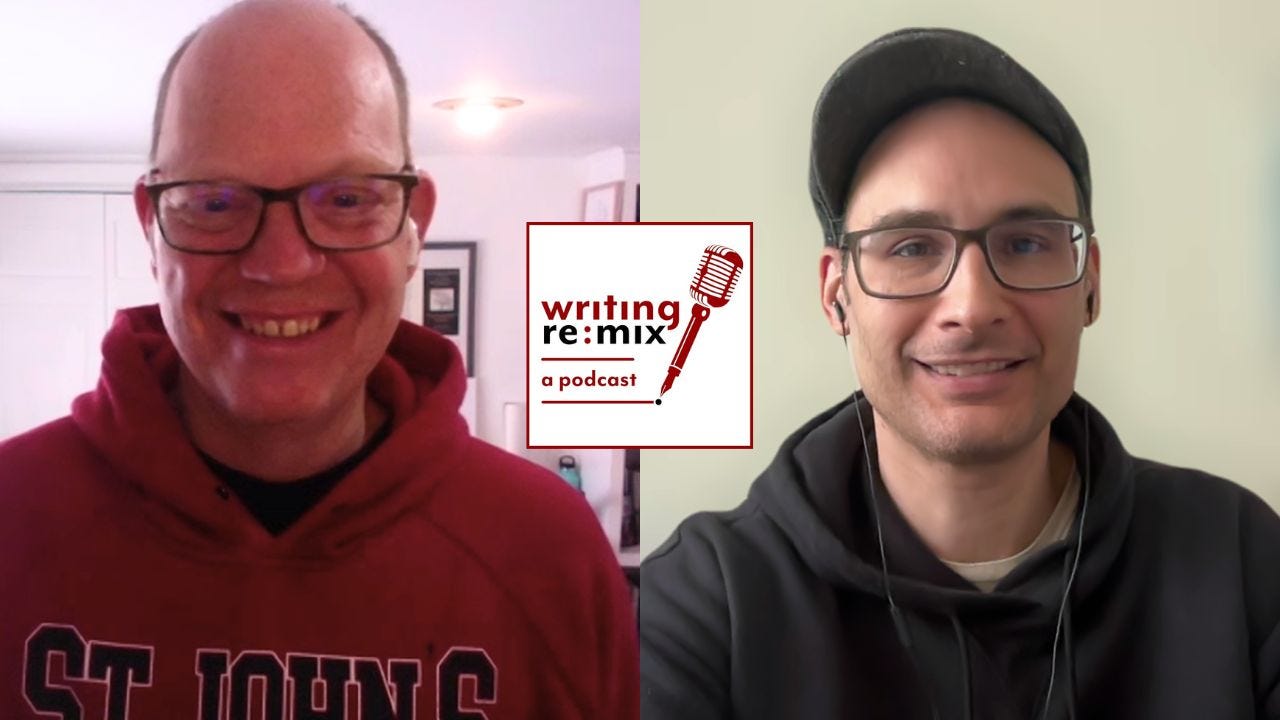
“Water is, of course, one of the relatively few substances that we engage with in all three of its physical states, liquid, solid, and gas. And [...] there's all sorts of ways in which this substance is sort of fascinating to us on a physical and cultural level.”
-Dr. Steve Mentz
Our existence is a fully embodied one. This is something I have to continually remind myself of because I have a tendency to be lost in my mind most of the time. The above quote helps to remind me to be fully embodied, in the present moment, and to ground myself in the various stages of my existence. In this episode with Dr. Steve Mentz he speaks to a fully embodied approach to scholarship, a fully embodied writing practice, a fully embodied reading practice, and a fully embodied living experience.
To engage with water is to engage with life which means to be at the intersection of one’s mind, body, and spirit. When we’re stuck in the mind, we aren't even a fraction engaged with the present because we’ve chosen to over- intellectualize. This approach unnecessarily complicates and separates us from ourselves, our communities, from each other, and even from our mortality. To live in our minds at all times is to ignore the miracles and magic of the mundane, our bodies’ pleasures and pains, the open communication we have with our ancestors if we step outside our heads and engage in our spirits. We sever ourselves from the energy in the air surrounding us and filing our lungs, the frozen geometry of a single snowflake, and the symbiotic and eroticism of our relationship to the ocean.
To live in our heads is to stay asleep in the void of this deficit.
The podcast episode with Dr. Steve Mentz is a special one for me because Dr. Mentz was a professor of mine during my doctoral work at Saint John’s University in NY. He is someone that I deeply respect as a scholar, a writer, and a person, and to be sitting across from him, virtually on zoom, was an honor.
I can't lie though, it was also a bit intimidating because he’ll always be "Dr. Mentz," no matter how many times he tells me to call him Steve, he’s Dr. Mentz. Yet, Steve can do something that a lot of academics can’t do, he can engage in a conversation at the deeply human level. It was like we were both just sitting on a beach somewhere in front of the ocean trading memories back and forth about swimming, childhood, and poetry, you know, the important stuff.
Poetry is a language that adapts to the body it's being released from. It's an unruly language, a beautifully wild language that encompasses alphabets beyond our comprehension. Poetry crosses the borders between generations and history to carry knowledge that cannot be contained inside prose. In his book Sailing without Ahab Dr. Mentz examines the intricate, odd, and vast landscape of Herman Melville’s Moby-Dick using multiple narrative “I” voices to uncover a deeply hidden and personal analysis of the text. He embarks into uncharted waters to find the ways in which a novel can become part of the readers mind, body, and spirit. He does this by writing a poem for each of the 136 chapters of the novel. He does this by developing a poetics that is fully embodied and shape shifts in and out of each of the chapters of Moby-Dick. It makes this classic text a hybrid experience.
“I think the secret history of all scholarship is some kind of personal obsession.”
-Dr. Steve Mentz
Poetry is an obsession. Scholarship is an obsession. As Dr. Mentz says in the above quote, to be a scholar is to be obsessed, to be a scholar is to search for something that only you see, to create scholarship is to create knowledge and poetry creates knowledge. Sailing without Ahab carves a space of new knowledge in the growing discourse on Moby-Dick. It’s a text that develops parallel and intersectional. The knowledge in the poems intersect and intercept the narrative of Moby-Dick and it adds a modern and much needed analytical take to the scholarship.
I hope everyone enjoys this episode, please leave your comments. Please share this episode with someone that you feel needs to hear this. And let's create together as much as we possibly can. Email your thoughts and questions to writingremixpodcast@gmail.com and I will answer them on a future episode.
Episode 111 Reflective Questions
This week's Reflective Questions ask us to consider how to make noise in public.
Take 15 minutes and write a list of all the things you are obsessed with. Don't hold back. There are no wring answers.
Write about your earliest memory involving the ocean. Be detailed.
For 20 minutes, write into uncharted waters.
Share your writing with us at writingremixpodcast@gmail.com, or post your thoughts on Instagram and tag the podcast @WritingRemixPod #InspiredBelonging and we'd love to read them on the next Inspired Belonging episode!
Listen to Episode 111, hit the like, restack, & share!
111. Sailing Without Ahab w/ Dr. Steve Mentz

Dan Dissinger welcomes back his former professor Dr. Steve Mentz, chair of the Saint John’s University English Department, to discuss his latest book of poems Sailing Without Ahab and the Blue Humanities. They dive into (no pun intended) Dr. Mentz’s writing journey in and out of the poems in